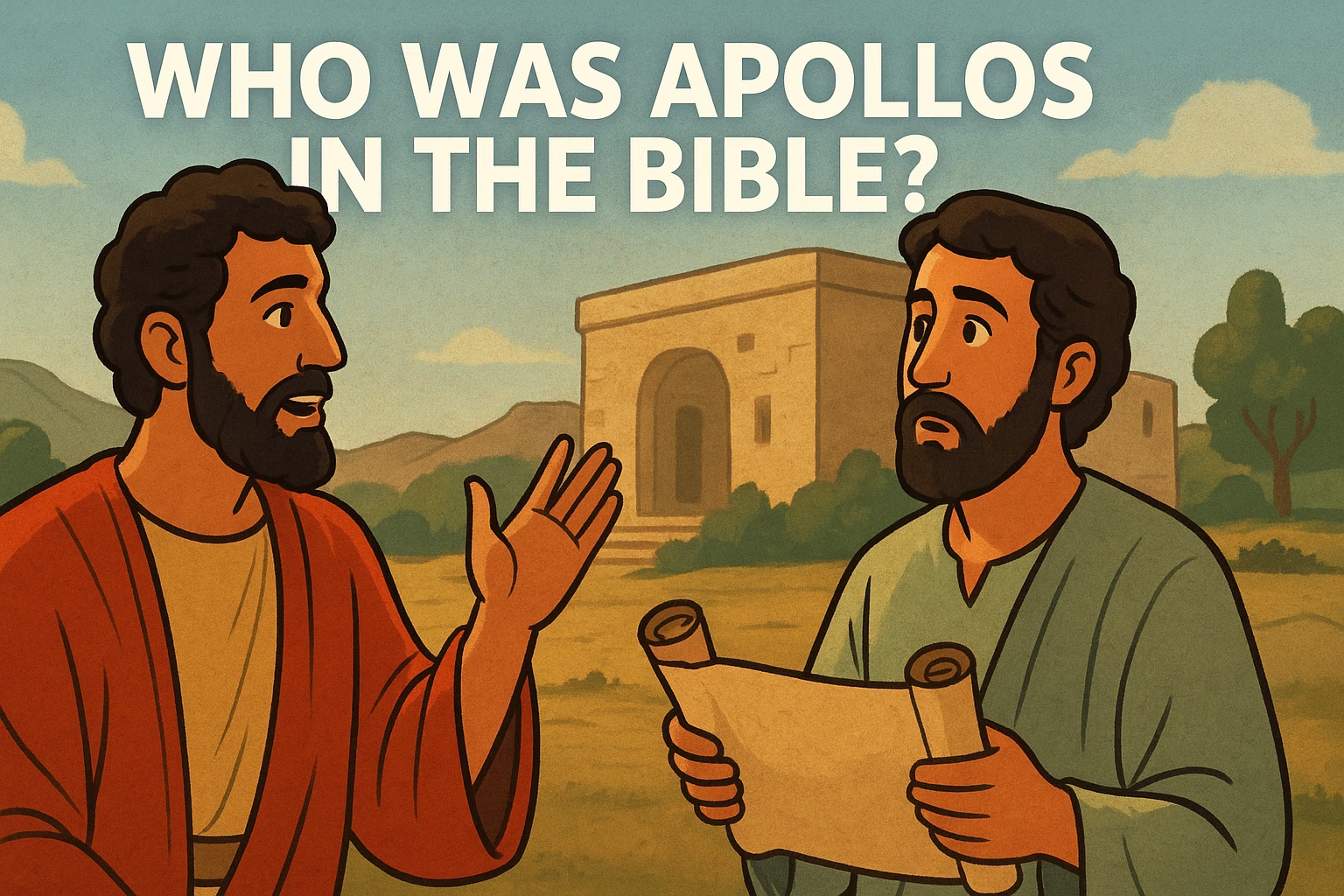
In the New Testament, Apollos is a significant figure who played a crucial role in the early Christian church. His story unfolds primarily in the Book of Acts and the letters of Paul, where he is portrayed as a learned and eloquent preacher. Understanding who Apollos was helps to appreciate the dynamics of the early church and the spread of the Gospel.
Apollos was a Jewish Christian from Alexandria, a city in Egypt known for its rich cultural and intellectual heritage. He is introduced in Acts 18:24-28, where we learn that he was “an eloquent man, well-versed in the Scriptures.” His background and education in Alexandria likely provided him with a deep understanding of the Jewish Scriptures, which he used to effectively communicate the message of Jesus Christ.
Apollos’s Early Life and Background
Apollos is described as a Jew from Alexandria, which was a center of learning and philosophical thought during the first century. Alexandria was home to the famous Library of Alexandria and was known for its diverse population and rich cultural exchanges. This background likely contributed to Apollos’s eloquence and knowledge of the Scriptures.
His name, Apollos, is a variant of the name Apollo, the Greek god of music and poetry, which suggests that he might have been named after this deity, reflecting the Hellenistic culture of his hometown. However, Apollos was a devout Jew and later became a follower of Christ, showing how the Gospel transcended cultural boundaries.
Apollos’s Ministry in Ephesus
Apollos’s ministry is first highlighted in Acts 18:24-28. After arriving in Ephesus, he began to speak boldly in the synagogue, teaching about Jesus. However, it is noted that he only knew the baptism of John at that time (Acts 18:25). This indicates that while he was knowledgeable about the Scriptures and the message of repentance that John preached, he was not yet fully aware of the implications of Jesus’s death and resurrection, which were central to the Christian faith.
His eloquence attracted attention, and he was soon approached by Aquila and Priscilla, a married couple who were also early Christian leaders. They recognized his potential and took him aside to explain “the way of God more accurately” (Acts 18:26). This moment illustrates the importance of mentorship and community in the early church, as Apollos was willing to learn and grow in his understanding of the Gospel.
Apollos’s Role in the Early Church
After receiving further instruction from Aquila and Priscilla, Apollos became an even more effective minister. He traveled to Achaia, where he greatly helped those who had believed through grace (Acts 18:27). His ability to argue convincingly from the Scriptures made a significant impact on the early Christian community, particularly in Corinth, where he became a prominent figure.
In 1 Corinthians 3:5-9, the Apostle Paul addresses divisions within the Corinthian church, where some members were claiming allegiance to different leaders, including Apollos. Paul emphasizes that both he and Apollos are merely servants through whom the Corinthians came to believe, highlighting the collaborative nature of their ministry. Paul planted the church, and Apollos watered it, but it is God who gives the growth (1 Corinthians 3:6). This passage illustrates the unity and purpose of their efforts in spreading the Gospel.
Apollos’s Influence and Legacy
Apollos’s influence extended beyond his immediate ministry. The fact that he was so highly regarded in Corinth demonstrates the impact he had on the early Christians. His eloquence and knowledge made him a powerful advocate for the faith, capable of addressing both Jewish audiences and Gentiles alike.
In addition to his preaching, Apollos is mentioned in Paul’s letters as someone who was well-respected and valued. In 1 Corinthians 16:12, Paul notes that Apollos was not willing to visit Corinth at that time, indicating that he had his own ministry priorities. This respect between Paul and Apollos is significant, as it shows a spirit of collaboration rather than competition in their shared mission.
Furthermore, Apollos’s journey reflects the broader theme of the early church’s expansion across cultural boundaries. His background as a Jewish scholar from a Hellenistic city allowed him to engage with diverse audiences, making the message of Christ accessible to many. His life exemplifies how God can use individuals from various backgrounds and experiences to accomplish His purposes.
While the New Testament does not provide extensive details about Apollos’s later life or ministry, his contributions to the early church remain evident. His story encourages believers to embrace their unique gifts and backgrounds, using them to further the Gospel and build up the church community.
Apollos and the Nature of His Teachings
Apollos’s teachings were rooted deeply in the Scriptures, and he was noted for his ability to connect Old Testament prophecies to the life and mission of Jesus. His method of preaching likely involved drawing parallels between the Jewish faith and the new covenant established through Christ. This was crucial in a time when many Jews were skeptical about Jesus being the Messiah.
As a learned individual, Apollos would have been familiar with various interpretations of Scripture, enabling him to engage in discussions with both Jewish leaders and Gentile converts. His understanding of the Scriptures allowed him to present compelling arguments that supported the claims of Jesus’s divinity and messianic role. This ability to articulate the Gospel effectively helped bridge the gap between Jewish tradition and the emerging Christian faith.
Mentorship and Community in Apollos’s Journey
The mentoring relationship between Apollos, Aquila, and Priscilla highlights the importance of community in the early church. After being instructed by this couple, Apollos was better equipped to spread the Gospel. This scenario emphasizes that no one is beyond learning, regardless of their background or experience.
In many ways, Apollos’s willingness to learn from Aquila and Priscilla serves as a model for contemporary believers. It demonstrates that the journey of faith is often enhanced through relationships and shared experiences. The early church thrived on such mentorship, where seasoned leaders helped new believers grow in their understanding of God’s Word.
Apollos’s Relationship with Paul
The relationship between Apollos and Paul is a fascinating aspect of early Christian leadership. In his letters, Paul makes it clear that he regards Apollos as a vital partner in ministry. Rather than viewing Apollos as a rival, Paul emphasizes their complementary roles in the church’s growth. This dynamic helps illustrate a foundational principle of Christian leadership: unity in diversity.
In 1 Corinthians 3:6-9, Paul writes about planting and watering, using agricultural metaphors to describe their respective roles. This passage reinforces the idea that each leader has a unique contribution to make, and all serve under the overarching authority of God. The success of the church depended not on competition among its leaders but on their collective efforts to serve the same purpose.
Apollos’s Impact on the Corinthian Church
The influence Apollos had on the Corinthian church is particularly noteworthy. His eloquent preaching and deep understanding of Scripture helped many believers grow in their faith. However, it also led to divisions within the church, as some members began to identify more with Apollos than with Paul. This issue highlights a common challenge within church communities: the tendency to elevate certain leaders over others, which can hinder unity.
Paul’s admonition in 1 Corinthians 1:12-13 addresses this issue directly. He emphasizes that the church belongs to Christ, not to individual leaders. This teaching is vital for contemporary churchgoers, reminding them that while leaders play important roles, the focus should always remain on Christ and His mission.
Apollos in the Context of Early Christianity
Apollos’s role in the early church is significant when viewed within the broader context of early Christianity. The early church was marked by rapid growth and a diverse range of beliefs and practices. Apollos’s ability to engage with both Jewish and Gentile audiences made him a key figure in the church’s expansion.
He represents a bridge between the Jewish roots of Christianity and the Gentile world, facilitating the spread of the Gospel across cultural boundaries. His story demonstrates how God can use individuals from different backgrounds to accomplish His will in diverse contexts.
Questions for Reflection and Further Study
As we consider the life and ministry of Apollos, several questions emerge that can deepen our understanding and application of his example:
- What can we learn from Apollos’s willingness to be mentored by Aquila and Priscilla? How can we cultivate a spirit of learning in our own faith journeys?
- In what ways can church leaders today foster unity among diverse groups within their congregations, as Paul and Apollos did?
- How can we apply Apollos’s example of eloquence and knowledge in our own discussions about faith with others?
- What role does the community play in shaping our understanding of Scripture, and how can we engage more deeply with fellow believers?
Conclusion: The Enduring Legacy of Apollos
Apollos remains a vital figure in understanding the dynamics of the early church and the spread of the Gospel. His eloquence, willingness to learn, and collaborative spirit with leaders like Paul serve as an example for Christians today. By examining his life, we are encouraged to embrace our unique gifts, seek mentorship, and work together to further the message of Christ. Apollos’s legacy reminds us that God can use anyone, regardless of their background or status, to advance His kingdom and enrich the community of believers.
For more insights on the early church and its leaders, you can explore these articles: understanding the role of early church leaders and the significance of mentorship in Christian communities.